The Clifton – Moon Phase Regulator with Three Weights

The Clifton – Moon Phase Regulator with Three Weights
Moon phase, three weights and a deep mahogany tone.
A curved mahogany-toned case reveals a silver dial with moon phase, three polished tubular weights and a long pendulum. A statement regulator with the presence of a much larger clock.
Not completely happy with your clock? You can send it back within 30 days of delivery.
🔒 Secure payment · your order is protected from checkout to delivery.
Description & details
Moon phase, three weights and a deep mahogany tone.
A curved mahogany-toned case reveals a silver dial with moon phase, three polished tubular weights and a long pendulum. A statement regulator with the presence of a much larger clock.
- Style: Collector's weight-driven regulator
- Case: Curved mahogany-toned case with glazed front
- Dial: Silver dial with moon phase
- Pendulum: Long pendulum with polished bob, three tubular weights
Dimensions: H 78.5 cm × W 22 cm × D 11.5 cm
A timeless piece, made to be admired every day and handed down.
How to use it
Place the clock on a level wall, shelf or floor, away from direct sunlight and heat sources.
To set the time, gently move the minute hand clockwise only. On pendulum models, start the pendulum with a light push and wind the movement regularly with the key provided.
How it works
The movement drives the hands and, on pendulum models, the steady swing of the pendulum regulates the timekeeping. If the clock runs fast or slow, a small adjustment of the pendulum bob corrects it: lower to slow it down, higher to speed it up.
Each clock comes with simple setup instructions, and our team is available by email if you need help.
Delivery
Home delivery is free on every order during our Black Friday offer. Each clock is carefully packed to protect its case, glass and movement.
As soon as your order ships you receive a confirmation email with your tracking number.
How the mechanism works
A traditional weight-driven longcase movement, the same principle clockmakers have perfected for centuries.
The brass weights hang on chains or cables. As they slowly descend, gravity drives the gear train that turns the hands and powers the strike and chimes.
The pendulum swings at a constant rate. Through the escapement, each swing releases the gear train by exactly one tooth: this is the familiar, reassuring tick-tock.
Winding raises the weights again. To adjust the rate, raise the pendulum bob slightly to make the clock run faster, or lower it to make it run slower.
Inside the movement
The beating heart of every clock
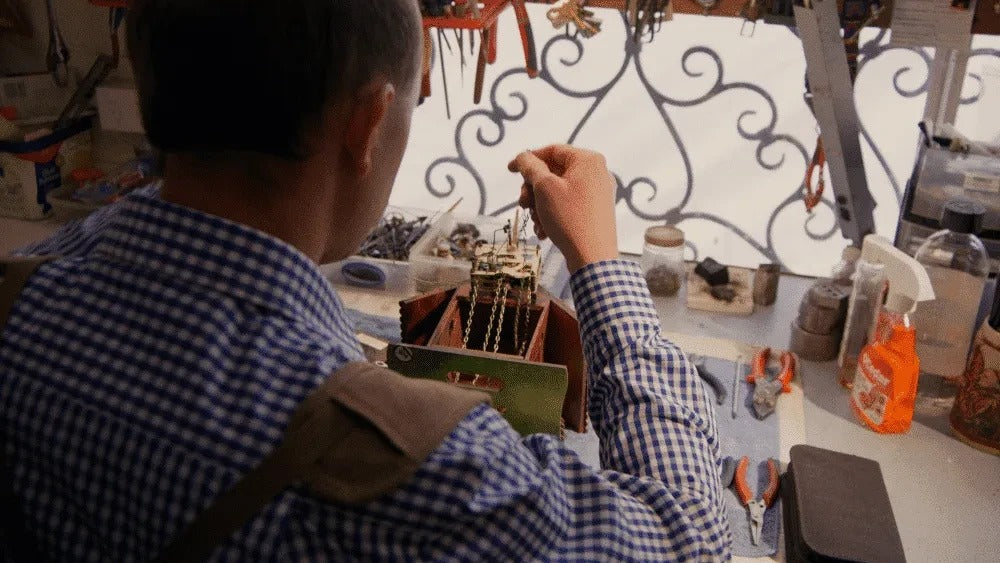
Behind each dial lies a mechanism of brass and steel, made of hundreds of parts working in perfect harmony. Here is how it works, and who brings it to life.
 Three-train chiming movement
How a mechanical clock works
A mechanical clock turns a simple force, gravity, into perfectly measured time. Four elements work together, second after second.
- 01The energyBrass weights, raised when you wind the clock, slowly descend on their chains or cables. Their pull is the only power the clock needs: no batteries, no electricity.
- 02The gear trainBetween two solid brass plates, a train of precisely cut wheels and pinions transmits that energy and turns the hands at exactly the right speed.
- 03The escapement & pendulumThe pendulum swings at a constant rhythm. With every swing, the escapement releases the gears by a single tooth: the steady tick-tock that keeps the time.
- 04The chimeA pinned barrel lifts a row of hammers in sequence. They strike tuned rods or tubes to play the melody each quarter hour, then count the hours.
 Precision brass movement
Built to be handed down
A good movement is not made to last a few years, but generations. The brass plates are thick and finely finished, the wheels are cut with precision, and every pivot turns smoothly to keep wear to a minimum.
With a little care, regular winding and occasional servicing, a mechanical clock keeps running, ticking and chiming for decades, and becomes part of the family story.
The people behind our clocks
The craftsmen we work with
Since 1945, clockmaking has been a family affair. Today we work hand in hand with experienced professionals who share the same standards.
Movement makers
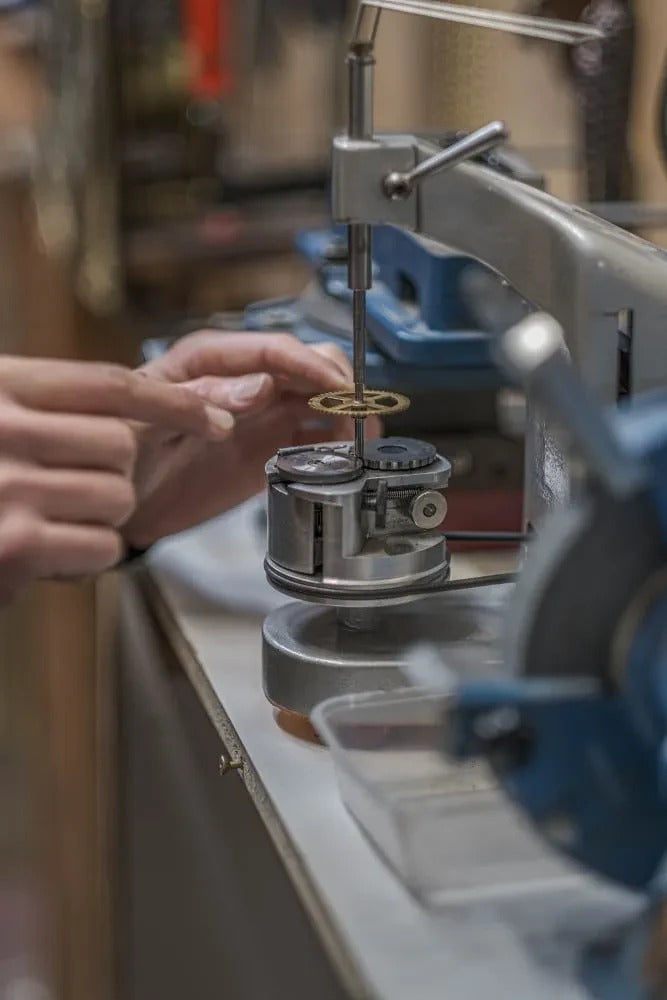
Specialists in mechanical movements who cut the wheels, assemble the brass plates and fit the escapement and chime, part by part.
Cabinetmakers
Woodworkers who shape, assemble and finish each case: carved hoods, turned columns, fine veneers and inlays, polished by hand.
Our clockmakers
They regulate each pendulum, check the timekeeping and the chime, then prepare the clock for a safe journey to your home.
 Chronicle Horlogerie
Since 1945
Our story
A craft handed down from generation to generation
Clockmaking has been part of our family since 1945. Long before Chronicle had a name, it lived in our workshops and living rooms: in the patient gestures of those who wound, repaired and cared for clocks, and in the know-how passed quietly from parents to children.
Chronicle Horlogerie was born from that heritage. Today we choose every clock for the same things that have always mattered to us: noble materials, honest craftsmanship and a movement worth listening to. Pieces made to be wound, admired and, one day, handed down in turn.


Inside our workshop
The hands behind every Chronicle clock
Movements assembled, regulated and checked with care by clockmakers who share our passion for fine timekeeping.