
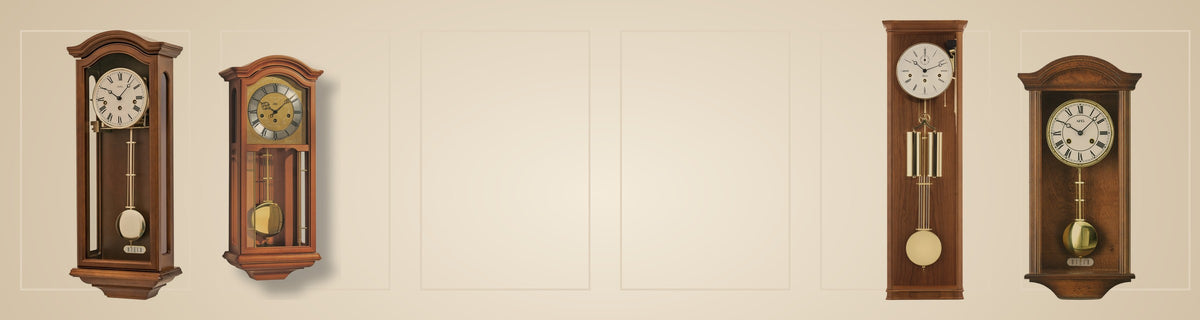
Wall Clocks
Pendulum and regulator wall clocks that bring character to any wall.


Free delivery Australia-wide
on orders over $199
Best price guarantee
Quality guaranteed
by renowned clockmakers
Expert assistance
Chat, email & phone
Inside our workshop
The hands behind every Chronicle clock
Movements assembled, regulated and checked with care by clockmakers who share our passion for fine timekeeping.




The wall clock guide
Everything you need to know about wall clocks
What they are, how they are built, how they work, where to hang them and what to check before you buy.
What is a pendulum wall clock?
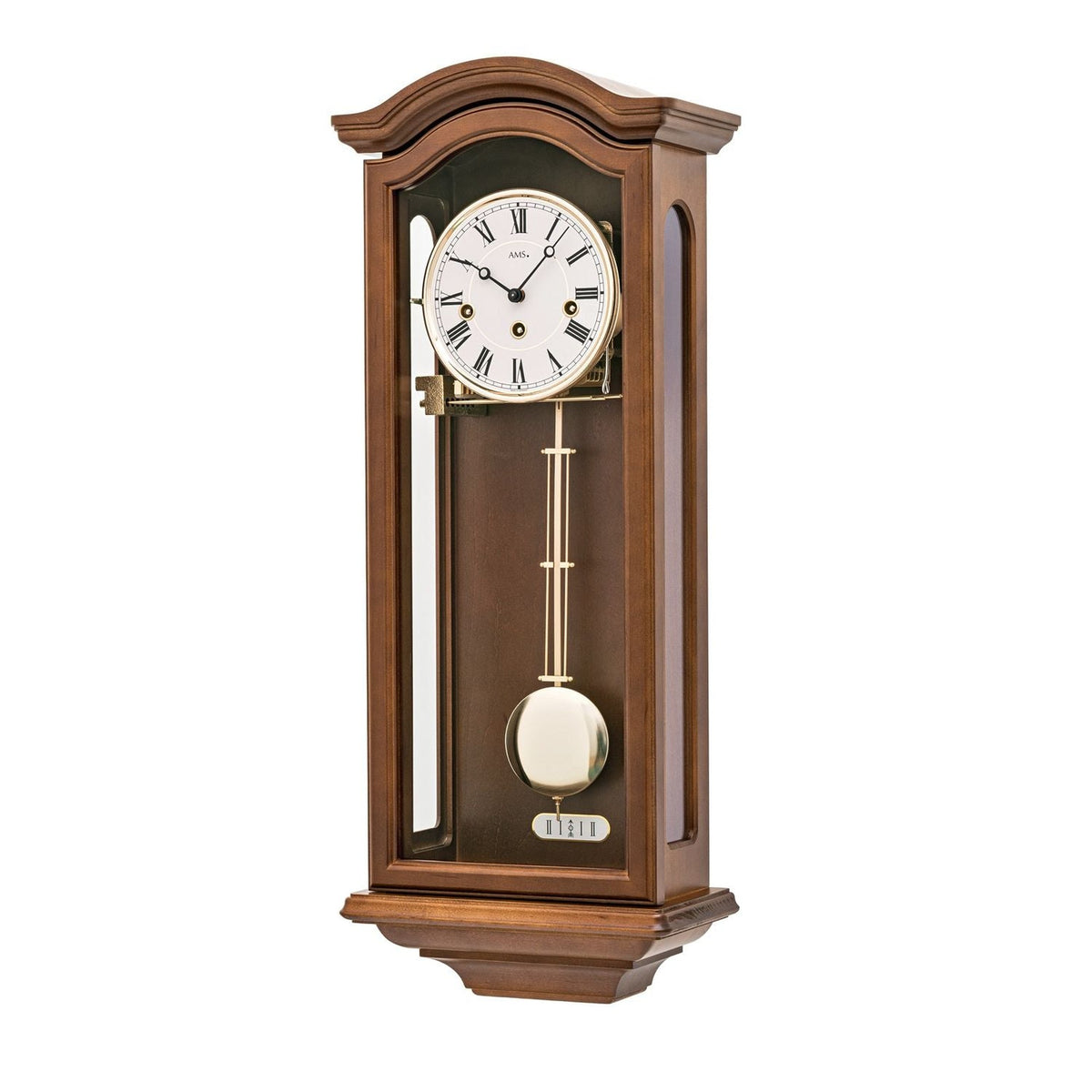
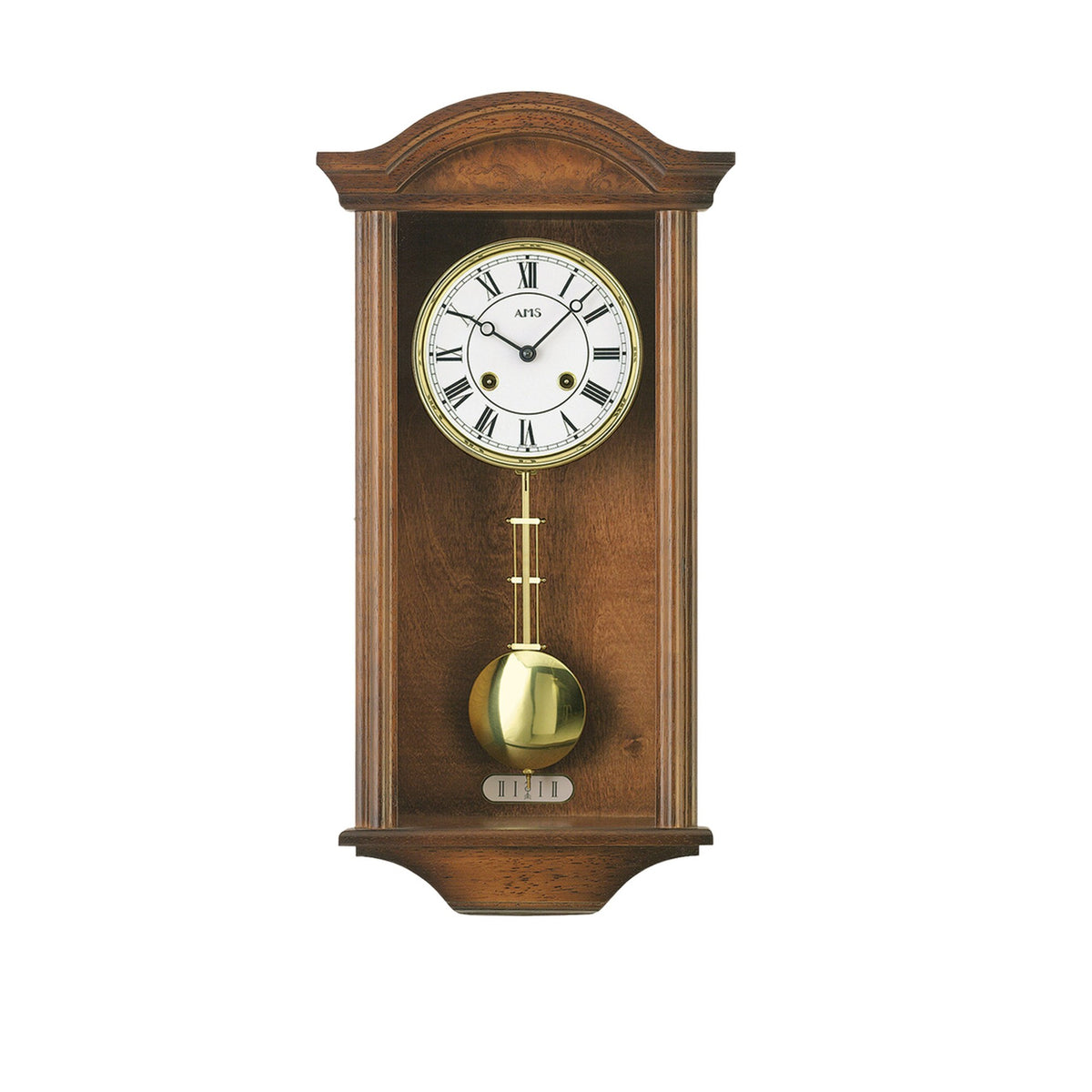
A pendulum wall clock is a clock designed to hang on the wall, with a visible pendulum swinging beneath the dial. The best-known type is the regulator: a tall, narrow wooden case with a glazed door that shows the dial, the pendulum and, on some models, the weights that drive the movement.
The name comes from the precision regulators of the 19th century, used by clockmakers and watchmakers to set other timepieces. Their long pendulum made them remarkably accurate, and their elegant cases quickly made them a favourite in homes, offices and shops.
Today, a wall clock combines two roles: it tells the time at a glance from across the room, and it brings warmth, movement and character to a wall, without taking up any floor space.
How a wall clock is built
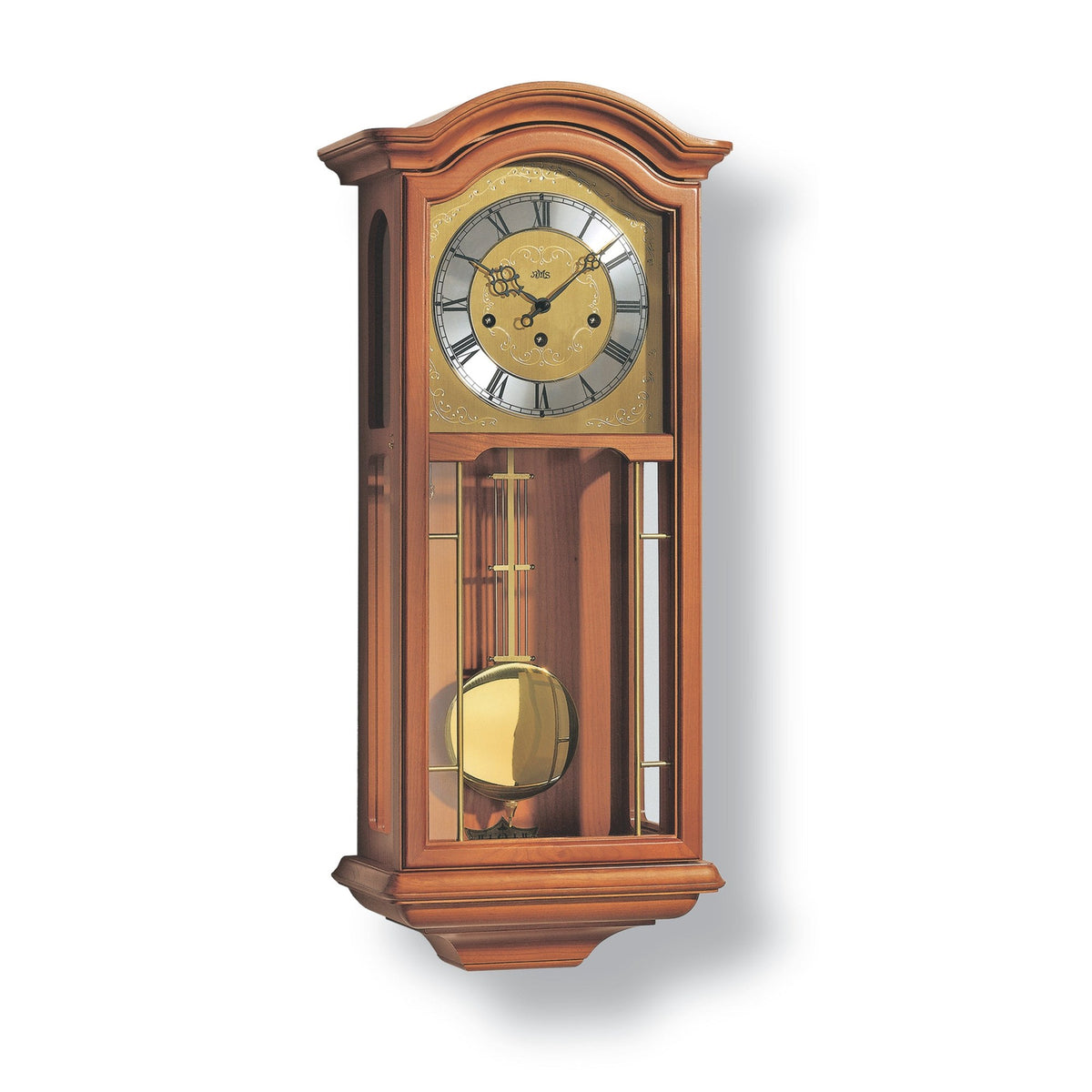
The case is the most visible part. Usually made of solid wood or wood veneer, it protects the movement and the pendulum and gives the clock its style: an arched or carved crown, turned finials, columns, a shaped lower panel or a clean contemporary box.
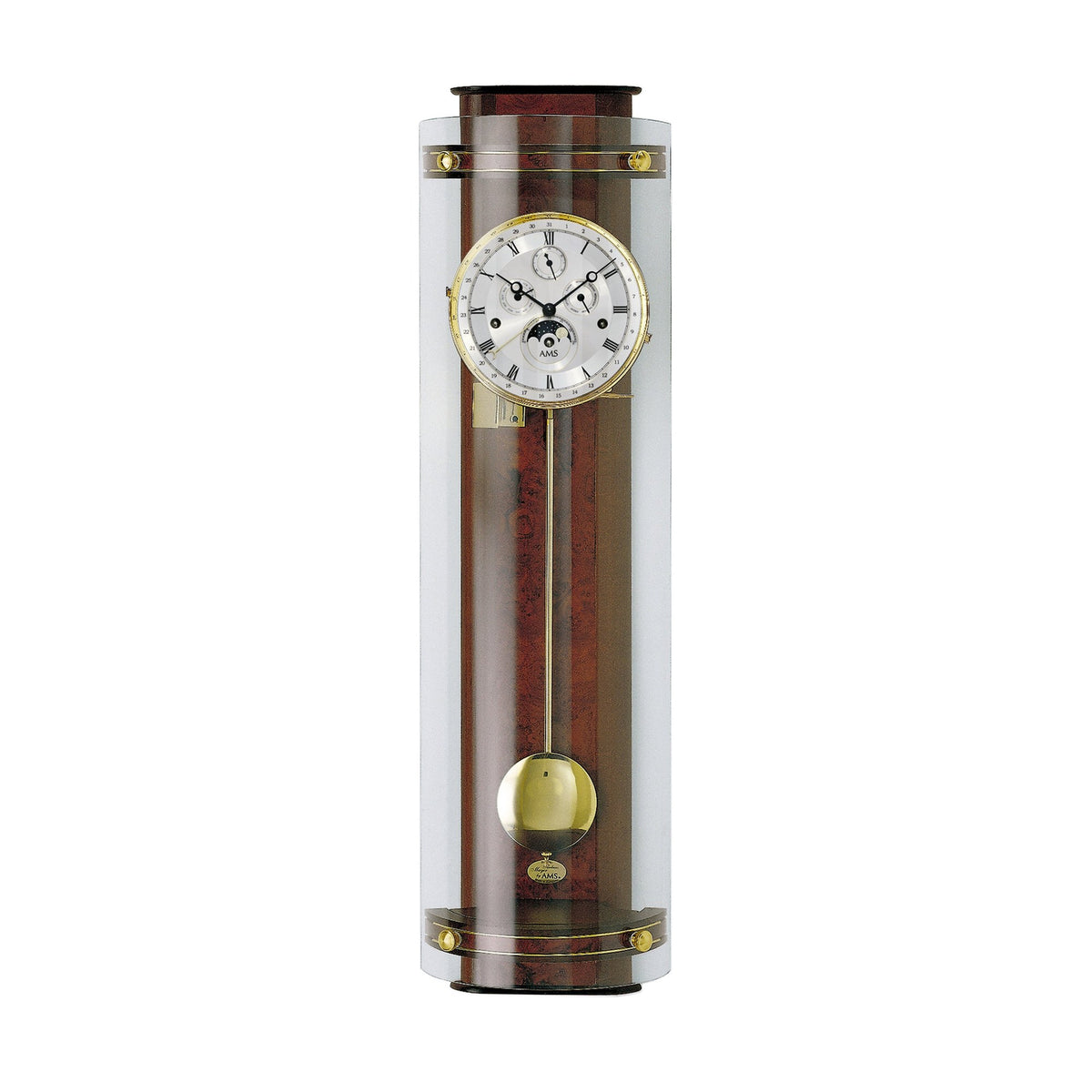
Behind the glazed door sits the dial, in silver, cream or brass, with Roman or Arabic numerals. Below it hangs the pendulum, often in polished brass, sometimes with a decorative lyre. On weight-driven regulators, one, two or three brass weights hang on chains or cables alongside it.
Inside the case, the movement drives the hands and, on chiming models, powers the hammers that strike the hours on gong rods. A small door or the hinged front gives access to wind the clock and set the time.
How does a wall clock work?
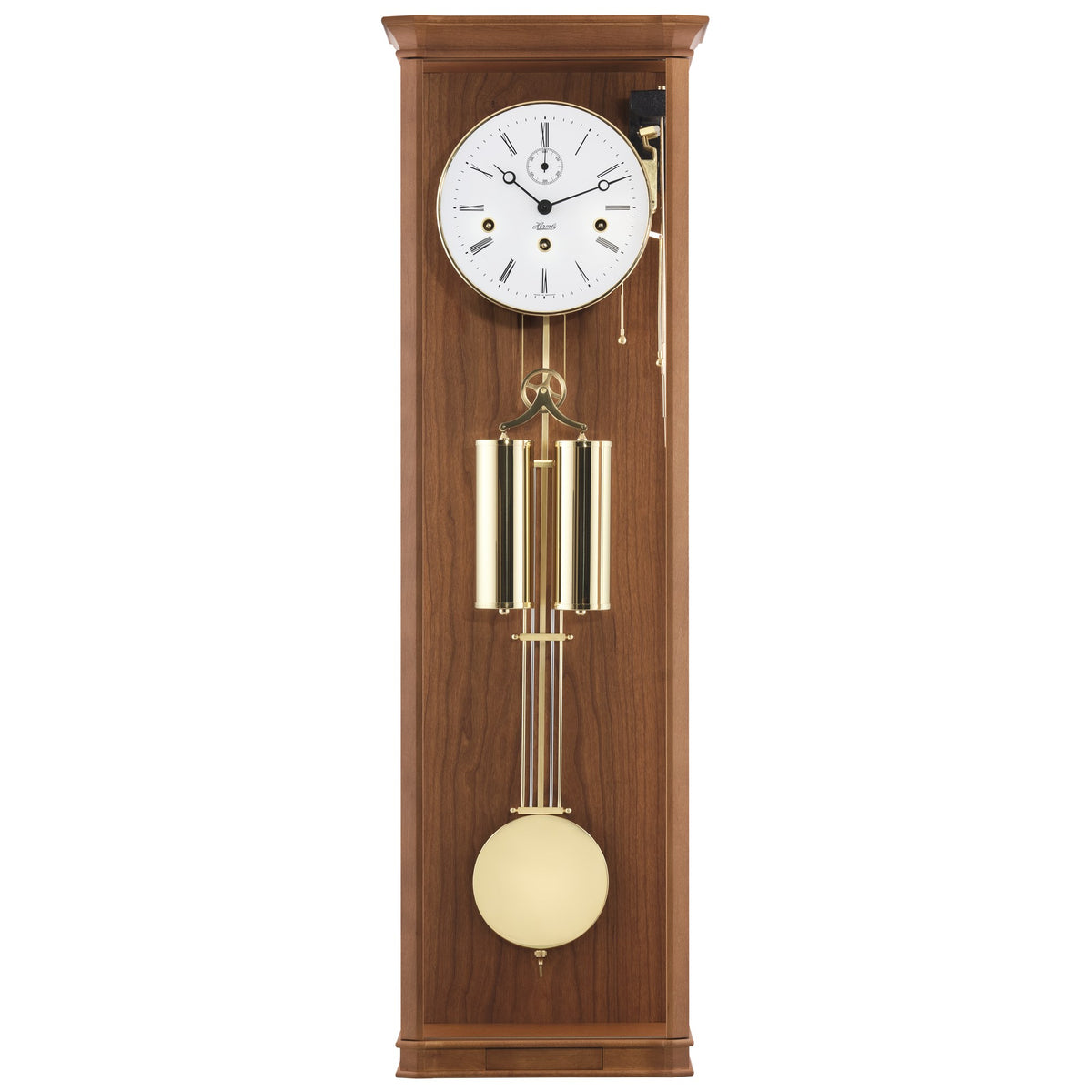
How a wall clock works depends on its movement. A weight-driven regulator is powered by gravity: the brass weights slowly descend and drive the gear train, while the pendulum and the escapement release that energy at a perfectly steady pace. Winding simply raises the weights again, usually once a week.
A spring-driven pendulum clock works the same way, but its energy comes from mainsprings coiled in brass barrels, tightened with a key. Many models run for eight days on a full wind and strike the hours, the half-hours or play a melody every quarter hour.
A quartz wall clock runs on a battery and needs no winding at all. Some quartz models keep a decorative swinging pendulum for the look, with the precision and ease of a modern movement.
Where and how to hang your wall clock
A wall clock looks its best in a hallway, a living room, a dining room, a study or above a sideboard. For a comfortable reading height, the dial is usually placed around eye level, between 1.6 and 1.8 metres from the floor; tall regulators can hang a little higher.
A pendulum clock must hang perfectly straight to keep good time. Fix it securely to a solid wall or a stud with suitable screws, then check it with a spirit level: the tick and the tock should sound evenly. If they do not, nudge the bottom of the case slightly left or right until the beat is regular.
Avoid walls next to a door that slams, above a heater, in full sun or in a damp room. Stable temperature and a still wall help the movement run reliably for many years.
What to look for when buying a wall clock
First, think about size. Measure the wall and imagine the clock in place: a long regulator suits a high ceiling or a stairwell, while a shorter model fits better above a piece of furniture or in a smaller room.
Then choose the movement. Mechanical clocks offer the charm of winding, the tick-tock and often a chime; quartz models are maintenance-free. If you love the sound, check the chime options, and whether the clock has a night silence or a volume setting.
Finally, consider the finish and the details: walnut, oak, cherry or a modern finish, the style of the dial, a moon phase or calendar, the pendulum and the weights. A well-made wall clock is a lasting piece, chosen to match your home for decades.